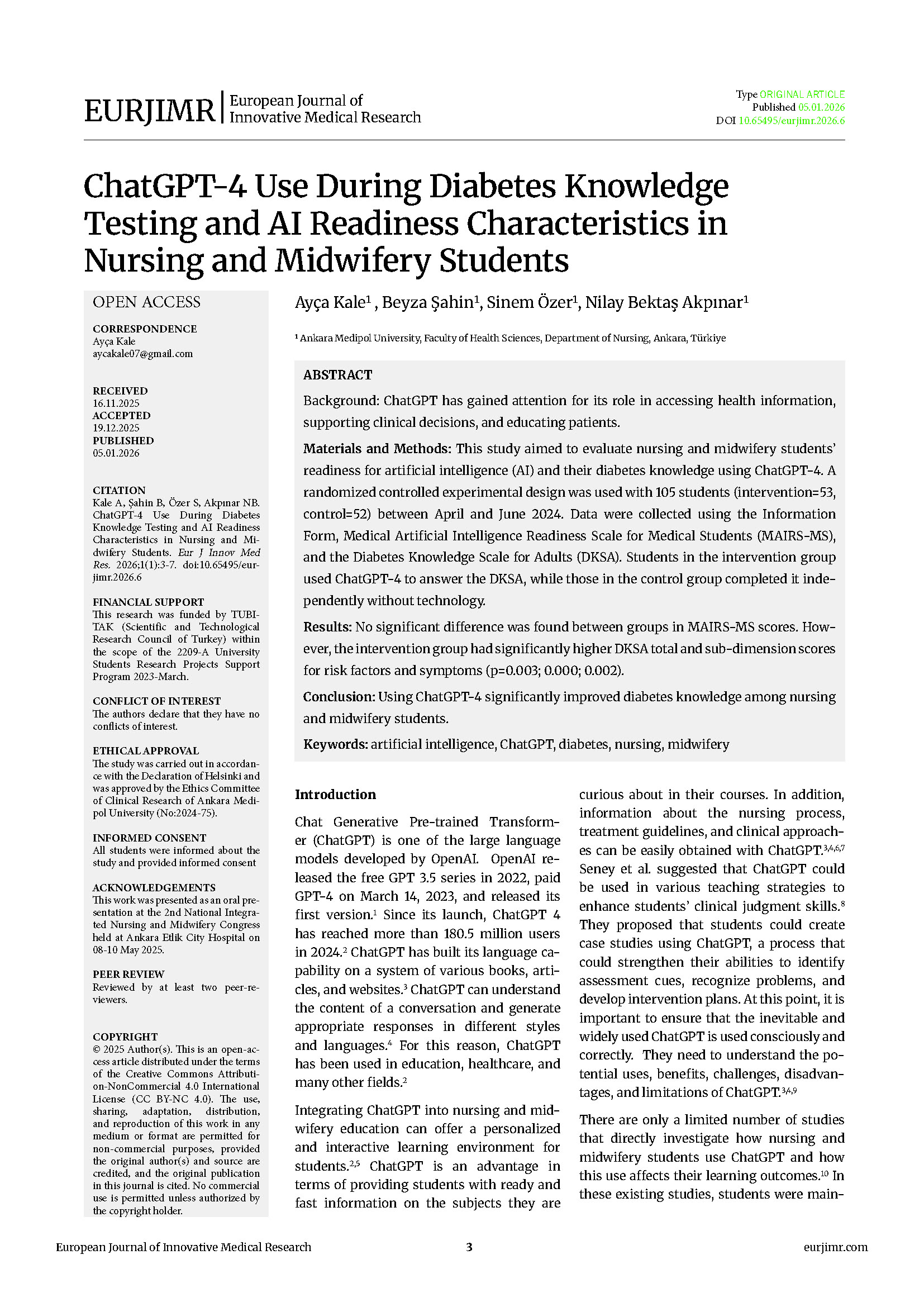
ChatGPT-4 Use During Diabetes Knowledge Testing and AI Readiness Characteristics in Nursing and Midwifery Students
DOI:
https://doi.org/10.65495/eurjimr.2026.6Keywords:
artificial intelligence, ChatGPT, diabetes, nursing, midwiferyAbstract
Background: ChatGPT has gained attention for its role in accessing health information, supporting clinical decisions, and educating patients.
Materials and Methods: This study aimed to evaluate nursing and midwifery students’ readiness for artificial intelligence (AI) and their diabetes knowledge using ChatGPT-4. A randomized controlled experimental design was used with 105 students (intervention=53, control=52) between April and June 2024. Data were collected using the Information Form, Medical Artificial Intelligence Readiness Scale for Medical Students (MAIRS-MS), and the Diabetes Knowledge Scale for Adults (DKSA). Students in the intervention group used ChatGPT-4 to answer the DKSA, while those in the control group completed it independently without technology.
Results: No significant difference was found between groups in MAIRS-MS scores. However, the intervention group had significantly higher DKSA total and sub-dimension scores for risk factors and symptoms (p=0.003; 0.000; 0.002).
Conclusion: Using ChatGPT-4 significantly improved diabetes knowledge among nursing and midwifery students.
References
1. OpenAI. Introduction to ChatGPT. Accessed April 18, 2025. https://openai.com/blog/chatgpt
2. Gunawan J, Aungsuroch Y, Montayre J. ChatGPT integration within nursing education and its implications for nursing students: A systematic review and text network analysis. Nurse Educ Today. Oct 2024;141:106323. doi:10.1016/j.nedt.2024.106323
3. Tam W, Huynh T, Tang A, Luong S, Khatri Y, Zhou W. Nursing education in the age of artificial intelligence powered Chatbots (AI-Chatbots): Are we ready yet? Nurse Educ Today. Oct 2023;129:105917. doi:10.1016/j.nedt.2023.105917
4. Ruksakulpiwat S, Kumar A, Ajibade A. Using ChatGPT in Medical Research: Current Status and Future Directions. J Multidiscip Healthc. 2023;16:1513-1520. doi:10.2147/JMDH.S413470
5. Labrague LJ, Aguilar-Rosales R, Yboa BC, Sabio JB, de Los Santos JA. Student nurses' attitudes, perceived utilization, and intention to adopt artificial intelligence (AI) technology in nursing practice: A cross-sectional study. Nurse Educ Pract. Nov 2023;73:103815. doi:10.1016/j.nepr.2023.103815
6. Gosak L, Pruinelli L, Topaz M, Stiglic G. The ChatGPT effect and transforming nursing education with generative AI: Discussion paper. Nurse Educ Pract. Feb 2024;75:103888. doi:10.1016/j.nepr.2024.103888
7. Yalcinkaya T, Cinar Yucel S. Bibliometric and content analysis of ChatGPT research in nursing education: The rabbit hole in nursing education. Nurse Educ Pract. May 2024;77:103956. doi:10.1016/j.nepr.2024.103956
8. Seney V, Desroches ML, Schuler MS. Using ChatGPT to Teach Enhanced Clinical Judgment in Nursing Education. Nurse Educ. May-Jun 01 2023;48(3):124. doi:10.1097/NNE.0000000000001383
9. Archibald MM, Clark AM. ChatGTP: What is it and how can nursing and health science education use it? J Adv Nurs. Oct 2023;79(10):3648-3651. doi:10.1111/jan.15643
10. O'Connor S, Yan Y, Thilo FJS, Felzmann H, Dowding D, Lee JJ. Artificial intelligence in nursing and midwifery: A systematic review. J Clin Nurs. Jul 2023;32(13-14):2951-2968. doi:10.1111/jocn.16478
11. Kwak Y, Seo YH, Ahn JW. Nursing students' intent to use AI-based healthcare technology: Path analysis using the unified theory of acceptance and use of technology. Nurse Educ Today. Dec 2022;119:105541. doi:10.1016/j.nedt.2022.105541
12. Makhlouf E, Alenezi A, Shokr EA. Effectiveness of designing a knowledge-based artificial intelligence chatbot system into a nursing training program: A quasi-experimental design. Nurse Educ Today. Jun 2024;137:106159. doi:10.1016/j.nedt.2024.106159
13. Khan I, Agarwal R. Can ChatGPT Help in the Awareness of Diabetes? Ann Biomed Eng. Oct 2023;51(10):2125-2129. doi:10.1007/s10439-023-03356-1
14. Barlas T, Altinova AE, Akturk M, Toruner FB. Credibility of ChatGPT in the assessment of obesity in type 2 diabetes according to the guidelines. Int J Obes (Lond). Feb 2024;48(2):271-275. doi:10.1038/s41366-023-01410-5
15. Nakhleh A, Spitzer S, Shehadeh N. ChatGPT's Response to the Diabetes Knowledge Questionnaire: Implications for Diabetes Education. Diabetes Technol Ther. Aug 2023;25(8):571-573. doi:10.1089/dia.2023.0134
16. Şah M, Göğebakan K. Comparing ChatGPT responses with clinical practice guidelines for diagnosis, prevention, and treatment of diabetes. In: EAI/Springer Innovations in Communication. Springer International Publishing; 2024:63–72.
17. Karaca O, Caliskan SA, Demir K. Medical artificial intelligence readiness scale for medical students (MAIRS-MS) - development, validity and reliability study. BMC Med Educ. Feb 18 2021;21(1):112. doi:10.1186/s12909-021-02546-6
18. Yavuz K, Erol S. Developing a Diabetes Knowledge Scale for Adults and its Psychometric Properties. Clinical and Experimental Health Sciences. September 2022;12(3):711-718. doi:10.33808/clinexphealthsci.1014888
19. Pinto Dos Santos D, Giese D, Brodehl S, et al. Medical students' attitude towards artificial intelligence: a multicentre survey. Eur Radiol. Apr 2019;29(4):1640-1646. doi:10.1007/s00330-018-5601-1
20. Montejo L, Fenton A, Davis G. Artificial intelligence (AI) applications in healthcare and considerations for nursing education. Nurse Educ Pract. Oct 2024;80:104158. doi:10.1016/j.nepr.2024.104158
21. Jairoun AA, Al-Hemyari SS, Shahwan M, Al-Qirim T, Shahwan M. Benefit-Risk Assessment of ChatGPT Applications in the Field of Diabetes and Metabolic Illnesses: A Qualitative Study. Clin Med Insights Endocrinol Diabetes. 2024;17:11795514241235514. doi:10.1177/11795514241235514
Downloads
Published
Data Availability Statement
Data are available upon reasonable request from the corresponding author.
Issue
Section
Categories
License
Copyright (c) 2026 Ayça Kale, Beyza Şahin, Sinem Özer, Nilay Bektaş Akpınar (Author)

This work is licensed under a Creative Commons Attribution-NonCommercial 4.0 International License.