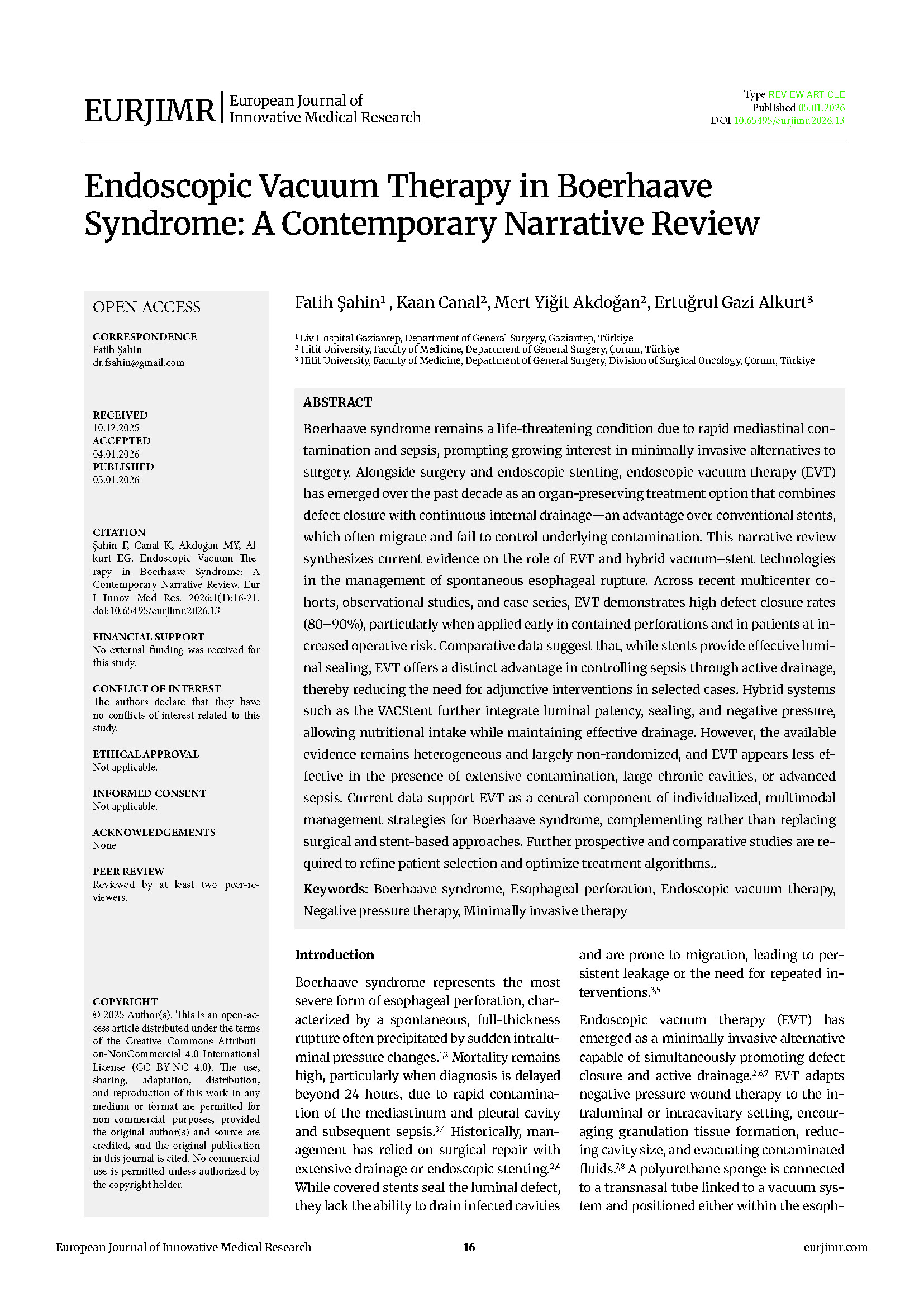
Endoscopic Vacuum Therapy in Boerhaave Syndrome: A Contemporary Narrative Review
DOI:
https://doi.org/10.65495/eurjimr.2026.13Keywords:
Boerhaave syndrome, Endoscopic vacuum therapy, Esophageal perforation, Negative pressure therapy, Minimally invasive therapyAbstract
Boerhaave syndrome remains a life-threatening condition due to rapid mediastinal contamination and sepsis, prompting growing interest in minimally invasive alternatives to surgery. Alongside surgery and endoscopic stenting, endoscopic vacuum therapy (EVT) has emerged over the past decade as an organ-preserving treatment option that combines defect closure with continuous internal drainage—an advantage over conventional stents, which often migrate and fail to control underlying contamination. This narrative review synthesizes current evidence on the role of EVT and hybrid vacuum–stent technologies in the management of spontaneous esophageal rupture. Across recent multicenter cohorts, observational studies, and case series, EVT demonstrates high defect closure rates (80–90%), particularly when applied early in contained perforations and in patients at increased operative risk. Comparative data suggest that, while stents provide effective luminal sealing, EVT offers a distinct advantage in controlling sepsis through active drainage, thereby reducing the need for adjunctive interventions in selected cases. Hybrid systems such as the VACStent further integrate luminal patency, sealing, and negative pressure, allowing nutritional intake while maintaining effective drainage. However, the available evidence remains heterogeneous and largely non-randomized, and EVT appears less effective in the presence of extensive contamination, large chronic cavities, or advanced sepsis. Current data support EVT as a central component of individualized, multimodal management strategies for Boerhaave syndrome, complementing rather than replacing surgical and stent-based approaches. Further prospective and comparative studies are required to refine patient selection and optimize treatment algorithms.
References
1. Predescu D, Achim F, Socea B, et al. Boerhaave Syndrome-Narrative Review. Review. Diagnostics (Basel). Sep 26 2025;15(19):30. 2463. doi:10.3390/diagnostics15192463
2. Schepis T, Boškoski I, Bove V, et al. Endoscopic management of esophageal perforations and tears. Review. Ann Esophagus. Mar 25 2023;6:13-13. 13. doi:10.21037/aoe-2020-28
3. Kooij CD, Boptsi E, Weusten B, de Vries DR, Ruurda JP, van Hillegersberg R. Treatment of Boerhaave syndrome: experience from a tertiary center. Surg Endosc. Apr 2025;39(4):2228-2238. doi:10.1007/s00464-025-11540-8
4. Schroder W, Leers JM, Bludau M, Herbold T, Holscher AH. [Perforations near the cardia in benign diseases]. Chirurg. Dec 2014;85(12):1064-72. Kardianahe Perforation bei gutartigen Erkrankungen. doi:10.1007/s00104-014-2805-z
5. Anundsen TK, Forland DT, Johannessen HO, Johnson E. Outcome after stent and endoscopic vacuum therapy-based treatment for postemetic esophageal rupture. Scand J Gastroenterol. Jan-Jun 2024;59(1):1-6. doi:10.1080/00365521.2023.2248537
6. Laukoetter MG, Mennigen R, Neumann PA, et al. Successful closure of defects in the upper gastrointestinal tract by endoscopic vacuum therapy (EVT): a prospective cohort study. Surg Endosc. Jun 2017;31(6):2687-2696. doi:10.1007/s00464-016-5265-3
7. Panneerselvam K, Jacob JS, Samuel RE, et al. Endoscopic vacuum therapy for treatment of spontaneous and iatrogenic upper gastrointestinal defects. Clin Endosc. Nov 2023;56(6):754-760. doi:10.5946/ce.2022.177
8. Newton NJ, Sharrock A, Rickard R, Mughal M. Systematic review of the use of endo-luminal topical negative pressure in oesophageal leaks and perforations. Dis Esophagus. Feb 1 2017;30(3):1-5. doi:10.1111/dote.12531
9. Sendino O, Loras C, Mata A, et al. Safety and efficacy of endoscopic vacuum therapy for the treatment of perforations and anastomotic leaks of the upper gastrointestinal tract. Gastroenterol Hepatol. Oct 2020;43(8):431-438. Eficacia y seguridad de la terapia de vacio endoscopica para el tratamiento de perforaciones y dehiscencias anastomoticas del tracto digestivo superior. doi:10.1016/j.gastrohep.2020.01.019
10. Soussi D, Alharahsheh BHA, Boshier PR, et al. Endoluminal Vacuum Therapy for the Management of Boerhaave Syndrome: A Case Series. Case Rep Gastroenterol. Jan-Dec 2024;18(1):402-411. doi:10.1159/000540694
11. Klose MA, Walldorf J, Damm M, et al. Treatment of esophageal leakages with the Microtech((R))-VAC-Stent: a monocentric early experience of three cases. Ther Adv Gastrointest Endosc. Jan-Dec 2023;16:26317745231200312. 26317745231200312. doi:10.1177/26317745231200312
12. Alakkari A, Sood R, Everett SM, et al. First UK experience of endoscopic vacuum therapy for the management of oesophageal perforations and postoperative leaks. Frontline Gastroenterol. Apr 2019;10(2):200-203. doi:10.1136/flgastro-2018-101138
13. Kehagias D, Abogabal S, Lampropoulos C, et al. VacStent as a novel therapeutic approach for esophageal perforations and anastomotic leaks- a systematic review of the literature. BMC Surg. Jul 21 2025;25(1):309. doi:10.1186/s12893-025-03067-5
14. Lange J, Dormann A, Bulian DR, Hugle U, Eisenberger CF, Heiss MM. VACStent: Combining the benefits of endoscopic vacuum therapy and covered stents for upper gastrointestinal tract leakage. Endosc Int Open. Jun 2021;9(6):E971-E976. doi:10.1055/a-1474-9932
15. Pattynama LMD, Eshuis WJ, van Berge Henegouwen MI, Bergman J, Pouw RE. Vacuum-stent: A combination of endoscopic vacuum therapy and an intraluminal stent for treatment of esophageal transmural defects. Front Surg. 2023;10:1145984. doi:10.3389/fsurg.2023.1145984
16. Luttikhold J, Pattynama LMD, Seewald S, et al. Endoscopic vacuum therapy for esophageal perforation: a multicenter retrospective cohort study. Endoscopy. Sep 2023;55(9):859-864. doi:10.1055/a-2042-6707
17. Wannhoff A, Kouladouros K, Koschny R, et al. Endoscopic vacuum therapy for the treatment of Boerhaave syndrome: a multicenter analysis. Gastrointest Endosc. Feb 2025;101(2):365-374. doi:10.1016/j.gie.2024.08.037
18. Saqib M, Iftikhar M, Ahmed K, et al. Esophageal stenting and endoscopic vacuum therapy for esophageal defects: a systematic review and meta-analysis of observational studies. Ann Med Surg (Lond). Sep 2025;87(9):5963-5972. doi:10.1097/MS9.0000000000003525
19. Ooi G, Burton P, Packiyanathan A, et al. Indications and efficacy of endoscopic vacuum-assisted closure therapy for upper gastrointestinal perforations. ANZ J Surg. Apr 2018;88(4):E257-E263. doi:10.1111/ans.13837
20. Ylli K, AlQahtani J, Hraishawi I, Murphy T. VACStent closure of oesophageal defects by covered stent and endoscopic vacuum therapy: initial use and clinical outcomes. J Surg Case Rep. Jan 2025;2025(1):rjae804. doi:10.1093/jscr/rjae804
21. Gruber M, Kollmann L, Friso Lock J, et al. Multimodal therapeutic options for esophageal perforations-a single-center experience. Front Surg. Oct 1 2025;12:1662261. 1662261. doi:10.3389/fsurg.2025.1662261
22. Halliday E, Patel A, Hindmarsh A, Sujendran V. Iatrogenic oesophageal perforation during placement of an endoscopic vacuum therapy device. J Surg Case Rep. Jul 28 2016;2016(7):4. rjw131. doi:10.1093/jscr/rjw131
23. Dhayat SA, Schacht R, Mennigen R, et al. Long-Term Quality of Life Assessment After Successful Endoscopic Vacuum Therapy of Defects in the Upper Gastrointestinal Tract Quality of Life After EVT. J Gastrointest Surg. Feb 2019;23(2):280-287. doi:10.1007/s11605-018-4038-9
24. Boonstra K, Pattynama LMD, van Herwaarden YJ, Eshuis WJ, Pouw RE. Endoscopic vacuum therapy in the upper gastrointestinal tract. Front Gastroenterol. Jan 17 2025;3:4. 1502682. doi:10.3389/fgstr.2024.1502682
Downloads
Published
Data Availability Statement
The data supporting the findings of this study are available from the corresponding author upon reasonable request. Due to patient privacy and ethical restrictions, raw clinical data cannot be publicly shared.
Issue
Section
Categories
License
Copyright (c) 2026 Fatih Şahin, Kaan Canal, Mert Yiğit Akdoğan, Ertuğrul Gazi Alkurt (Author)

This work is licensed under a Creative Commons Attribution-NonCommercial 4.0 International License.